Nov 16

Insights for Mormon Families… Insights for All Families…

What’s at the core of family and interpersonal conflict?  We all desire harmonious relationships and yet, in a way, we often perpetuate conflict by not recognizing our own part in it. This is known as self-deception.  Individuals who continually find scapegoats or who think the child, the other, is totally the problem, without relieving the self of an obligation to have a right view of the other that doesn’t engage the conflict or potentially real problem, can miss the mark.  Those who continually blame rather than stop to consider alternatives of forgiveness and of offering a blameless response, will continue to engage in a dance of conflict that results in destructive justifications and that seeks to add to a list of wrongs the other person has committed. Where there could be healing, there is further collusion, further hurt.  It takes a person to see another person as real–as flawed, perhaps, yes, but as real, to eliminate the kind of conflict that is so often perpetuated in relationships on any front.  Jim Ferrell (Latter-day Saint ["Mormon]” leader, author, and co-founder of the Arbinger Institute) speaks to these core issues–unresolved by many who strove to create therapeutic solutions–often that undermine the healing process, rather than lead out of it–which have been unraveled and distilled by Terry Warner in his application of gospel principles in lay terms, and in application of the words of the Martin Buber, illustrating that we can see the world in one of two ways–and people in one of two ways–as objects or as real people. This may seem simple, but the implications of this are stunning. See this video — it applies to all faiths and families–Mormon families, Jewish families, Muslim families, atheist families, blended families, single families–and to all individuals in relation, married, single, divorced, widowed, childless, child-bearing.

Additional Resources:

Learn more about Mormons who are in business.

Learn about Mormons in general.

Mormon Views of Jesus Christ & Christmas.


Nov 11

Valerie Steimle has been writing as a family advocate for the past 20 years. She is the mother of nine children living in southern Alabama and is the author of four books and a weekly newspaper column, Thoughts from the Heart.

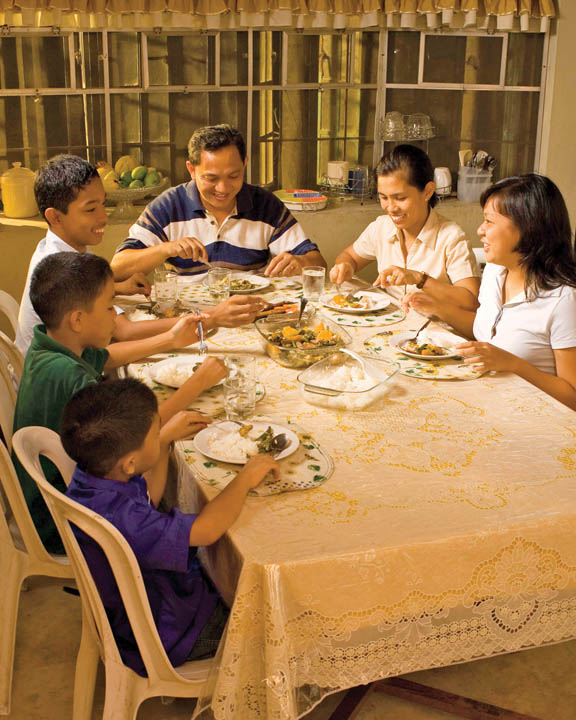
Family Dinner Can Make a Difference

From the time that my oldest child (I have nine) could talk, we have eaten dinner together around the kitchen table.  Even with the interruption of TV shows, sporting events and unwilling participants, I have always thought that eating dinner together at least 3 days a week was important.  I didn’t know why I felt this way, but I did and insisted that we sit down to dinner together as many times as we could during the week.  I have given in every so often to a “picnic” dinner in front of the television or eating in shifts at certain times but for the most part I have been successful in scheduling dinner times together and it was a good time for me to check in with my children.  Today, 30 years later, we are still doing this with my youngest three and many times our dinner conversations would be the start of a great evening.
Read the rest of this entry »

Nov 4

Valerie Steimle has been writing as a family advocate for the past 20 years. She is the mother of nine children living in southern Alabama and is the author of four books and a weekly newspaper column, Thoughts from the Heart.

Teenagers are fun.  That statement draws a lot of attention.  Some parents are afraid of their teenagers, while others enjoy the time their children are in their teens.  It takes courageous parents to guide their teenage children through the pit falls and bumps in their early life.  Teenagers are hanging on the eve of adulthood and it’s their last ditch effort to fulfill what they consider being “themselves”.  Many have passions about what they do and it shows in their actions. Others pass through quietly and contribute thoughtfully. One thing for sure, there is a lot more activity with a house full of teenaged children than with a house full of two year olds. Reflection and words of wisdom can help parents understand their teenage children so life runs smoother and safer especially those families of Christian/Judean ethics. Here are a few:

Parents Can Lay the Foundation:

Mormon youthChildren between the ages of 13 and 19 keep homes very invigorated and parents young as during adolescent time great changes take place in body and mind.  Parents should pay particular attention to what their teens do instead of turning a deaf ear to their activity. Granted, a two-year old will try to please his parents and for the most part, they go along with clothing choices, most foods to eat and bed time rules. But a teen causes parents to think through religious beliefs, moral judgments and why we should eat nutritious food for lunch instead of potato chips and soda pop. Teens, who are grounded in righteous endeavors typically will be more successful in this difficult world. Words of wisdom could never be truer from David B. Haight, a member of the Quorum of the Twelve, church leader for The Church of Jesus Christ of Latter Day Saints (LDS) back in April of 2003. From a talk given he says: “Though the world is becoming more wicked, the youth of Christ’s church can become more righteous if they understand who they are, understand the blessings available, and understand the promises God has made to those who are righteous, who believe, who endure. All of our youth are entitled to and need this knowledge to combat the forces of deception that would lead them captive into darkness.” Teens might think their parents are too strict with high morals but adolescent children know where they stand and that their parents’ care enough to enforce sensible values. Read the rest of this entry »