Jan 17

Valerie Steimle is a member of The Church of Jesus Christ of Latter-day Saints (a “Mormon” woman). She has been writing as a family advocate for the past 20 years. She is the mother of nine children living in southern Alabama and is the author of four books and a weekly newspaper column, Thoughts from the Heart.

It’s a new year to start afresh with our families in accomplishing our goals and aspirations.  A new year motivates us to reflect on how we can improve our lives together with our families. Members of The Church of Jesus Christ of Latter Day Saints (inadvertently called the “Mormon Church” by friends of other faiths) make it a practice to read the holy scriptures together as a family every day.  Reading from both the Bible and The Book of Mormon: Another Testament of Jesus Christ, will bring feelings of love, peace, joy, and comfort in the home.  As we read scriptures together as a family, we can reflect on the examples we read about ancient families in these scriptures.

Christian FamilyWe first learn from the example of ancient families how it is important to record family history.  Writing down our generations of family members helps to keep that connection from one generation to another.  There are generations of family histories preserved in the scriptures, and we can do the same with our own history and record what we experience in our journals.

Second, regular scripture reading as a family helps us to receive impressions of how we can handle difficult situations.  For example, reading the story of Lehi (an ancient prophet who testified of Jesus Christ) and Sariah from the Book of Mormon when their rebellious sons turn away from their father’s admonitions helps parents understand what they can do with their own wayward children.  Or the lesson from the Prodigal Son in the New Testament can give support to any parent whose child has chosen the wrong path and then decides to come back to the fold. Read the rest of this entry »

Jan 17

Valerie Steimle is a member of The Church of Jesus Christ of Latter-day Saints (a “Mormon” woman). She has been writing as a family advocate for the past 20 years. She is the mother of nine children living in southern Alabama and is the author of four books and a weekly newspaper column, Thoughts from the Heart.

Real family entertainment is difficult to come by at times. As a parent, we check to make sure whatever we watch, read or listen to is tame enough for our children. Raw language, over dramatized violence, and inappropriate relationships seem to be the norm in our culture. Sometimes, it’s even snuck in children’s full length feature cartoons. As members of The Church of Jesus Christ of Latter-day Saints, we pay particular attention to the rating, language content, and violence of movies as we have been admonished by our church leaders.

strengthen familiesThis past year was a pretty good one for good, clean, uplifting movies. Some good examples of inspiring movies are: Soul Surfer, A Dophin’s Tale, Hugo and even Gnomeo and Juliet. No inappropriate language, no over dramatized violence and no nudity or inappropriate relationships. The stories were interesting and uplifting as well.

How can we tell for ourselves and then guide our children on which movies are appropriate to watch as well as interesting, showing the correct example and moral principles? The movie making business unfortunately, for the most part, is not family friendly. Read the rest of this entry »

Jan 16

By Amy Choate-Nielsen

Deseret News
Published: Sunday, Jan. 15, 2012 7:00 p.m. MST

David Letterman knows how to get a laugh.Like most comics, he riffs on the day’s news, deadpans the camera and revels in audacity.”Oh, did you hear about this?” the host of CBS’ Late Show with David Letterman asked his audience recently. “A campaign staffer on the Newt Gingrich campaign was fired because he was making negative comments about Mormons. I thought, now, wait a minute — isn’t Newt in favor of multiple wives?”
Mormons say polygamy wrongLaughter rumbled from the audience followed by applause. The polygamy punch line is a familiar one when it comes to poking fun at Mormons — as though Mormons and polygamy are synonymous in mainstream media. Ironically, the practice that’s most linked to Mormons is a practice most Mormons oppose, according to a groundbreaking new study of Mormons in America released Thursday by the Pew Research Center‘s Forum on Religion and Public Life.

According to the study, members of The Church of Jesus Christ of Latter-day Saints unequivocally reject polygamy — only 2 percent said the practice is morally acceptable — evidence of a yawning gap in what Mormons believe and how they are perceived. Mormons’ opinions are overwhelmingly conservative, the study shows, but in many ways, their views are also surprising — especially when it comes to opinions on moral issues, divorce, homosexuality and polygamy. Read the rest of this entry »

Jan 16

A recent The Pew Research Center‘s Forum on Religion and Public Life conducted an in-depth survey of Mormons in the United States. Mormon is a nickname sometimes used to describe members of The Church of Jesus Christ of Latter-day Saints. The fourth article in a series that appears in Deseret News is evaluating the results of this survey and providing context for the results.

Immigration is a controversial topic in the United States. The survey asked one question on this topic. They were asked which of two statements most closely matched their view, even if they didn’t completely agree. They were asked whether immigrants strengthen or burden the nation. No distinction was made between legal and illegal immigration, leaving those polled to decide for themselves what the question meant.

Mormon Immigration views from Pew StudyIn the general U.S. population, 45 percent of Americans feel that immigrants strengthen the country, while 44 percent burden it. 12 percent feel that neither or both are true or they have no opinion on the subject. Mormon views closely mirror these statistics. 45 percent of Mormons also believe immigrants strengthen the nation, although a smaller number, 41 percent, consider them a burden on society. The number of Mormons who accept both or neither or who have no opinion is higher, at 14 percent.

These numbers put them at odds with evangelical Christians, one of the few political areas in which they disagree. Within the white evangelical population, 59 percent believe immigrants are a burden, and 27 percent believe they strengthen the country. Like Mormons, 14 percent answered both, neither, or no opinion.

The statistics for Mormons shows a strong divide based on age, income, and education, as well as on religious commitment. Only 36 percent of highly committed Mormons see immigrants as a burden, while 50 percent of those who are less committed see them as a burden. This largely correlates with economic status. 84 percent of Mormons who are highly committed to their religion are college graduates. (The church strongly encourages education, which may be a factor in this.) Only 50 percent of those with high school educations are strongly committed to their faith. This statistic is very unusual in the religious world. For most religions, the least educated are the most religious.

49 percent of Mormons under age 50 see immigrants as a strength. 39 percent of Mormons over 50 see it as a strength.

Beyond the study’s statistics, several other factors influence the Mormon view of immigration. Many Mormons serve missions for their church. For two years, they live wherever they are sent, learning the language and living as the people in that community live. They go into the homes, attend the churches, and do service work in addition to their missionary work. Many of those serve in Spanish countries and have a realistic view of the hardships faced by those people. They come home with a compassionate view of the world and an understanding that Americans have much easier lives than most. The love missionaries almost invariably develop for the people they served influences their views on immigration.

Finally, the church has taken very specific stands on the subject of illegal immigration in recent years. Mormons believe God has sent a prophet to lead His church, just as He has always done in ancient times, and so, Mormons are asked to sustain the prophet as the leader of the Church. Official statements from the prophet or the Church are considered to be from God.

The Church officially endorsed the basic principles of the Utah Compact, a law working to create a balanced legal approach to immigration. In November, 2011, L. Whitney Clayton gave an official statement from the church in honor of the first anniversary of the bill. The statement said in part:

The Utah Compact is consistent with three principles we believe should be carefully balanced when considering immigration:

  • We follow Jesus Christ by loving our neighbors. The meaning of neighbor includes all of God’s children, in all places and in all times.
  • We recognize an ever-present need to strengthen families. Families are meant to be together. Forced separation of working parents from their children weakens families and damages society.
  • We acknowledge that every nation has the right to enforce its laws and secure its borders.

We continue to encourage lawmakers everywhere to consider laws that properly balance love of neighbors and the importance of keeping families together, within the framework of just and enforceable laws.” (See Utah Compact One-Year Anniversary Marked by Utah Community Leaders.)

The official Mormon position is to encourage its members to stay in their homelands or to immigrate legally, but once they are here, however they came, they are to be treated with love, dignity, and respect, and laws should not separate families.

For a more in-depth look at the issue of Mormons and immigration, read the Deseret News article: Mormons’ immigration attitudes set them apart, by Eric Schulzke, Deseret News, published: Saturday, Jan. 14, 2012 8:12 p.m. MST.

Enhanced by Zemanta
Jan 14

Of all the numbers in the Pew Research Center’s recently released survey of “Mormons in America,” the highest, most overwhelming numbers are these: 98 percent of respondents said they believe in the Resurrection of Jesus Christ, and 97 percent say their church is a Christian religion.

Pew Study: Mormon Beliefs, Religious CommitmentThis comes on the heels of earlier surveys indicating that 32 percent of non-LDS U.S. adults say the LDS Church is not a Christian religion, and an additional 17 percent are unsure of LDS Christianity. The theological and semantic reasons for this can be complex, but for the 1,019 self-identified Mormons who participated in the Pew survey, their theological position is clear: Mormons believe in Jesus Christ, and they consider themselves to be Christian.

“Certainly in Latter-day Saint theology is this idea that if you understand who you are, you understand that there’s a purpose in life, you understand your connection to God, that certainly has an impact on how you live your life and what you do, but also how you feel about your life and what you are doing,” said Michael Purdy of the LDS Church Public Affairs office. Read the rest of this entry »

Jan 13

SMITHFIELD — After dinner, three baths, four bedtime stories and a half-a-dozen goodnight kisses for 2-year-old twins Brock and Isaac and 6-year-old Ellie, Erin and Brian Thompson finally sink into the couch with weary smiles.

Being parents is just what they always wanted. And they love it.

“Of course we have our crazy moments,” Thompson says, “but for the most part we just try to find the good things in the day and remember that they’re only going to be little for so long.”

Mormon family marriage focus PewAs members of The Church of Jesus Christ of Latter-day Saints, the Thompsons believe that maintaining a strong marriage and raising and teaching children are essential keys to happiness and their most important responsibilities on earth.

In fact, 81 percent of Mormons say being a good parent is “one of the most important things in life,” according to a new survey by the Pew Research Center‘s Forum on Religion & Public Life — the first survey of Mormons about Mormons, by a non-LDS research organization. Read the rest of this entry »

Jan 12

As the “Mormon moment” extends into 2012, the Pew Research Center’s Forum on Religion & Public Life today released a groundbreaking new survey, the first ever published by a non-LDS research organization to focus exclusively on members of The Church of Jesus Christ of Latter-day Saints and their beliefs, values, perceptions and political preferences.

Entitled “Mormons in America: Certain in Their Beliefs, Uncertain of Their Place in Society,” the survey was conducted between Oct. 25 and Nov. 16, 2011 among a national sample of 1,019 respondents who identified themselves as Mormons. The results validate a number of long-held stereotypes (most American Mormons are white, well-educated, politically conservative and religiously observant) while providing a few interesting surprises (care for the poor and needy is high on the list of LDS priorities, while drinking coffee and watching R-rated movies aren’t as taboo among the rank and file as you might think).

Pew Study on Mormons in America“While this survey comes amid a contentious election campaign, it is not solely or even chiefly about politics,” said Luis Lugo, Pew Research Center director, in the published survey’s preface. “Rather, we hope that it will contribute to a broader public understanding of Mormons and Mormonism at a time of great interest in both.”

For example, in one very interesting section of the new survey, respondents were asked several questions about what is essential to being a good Mormon. According to the survey, 80 percent said “believing Joseph Smith saw God the Father and Jesus Christ” is essential to being a good Mormon, 73 percent said “working to help the poor,” 51 percent said “regular Family Home Evenings,” 49 percent said “not drinking coffee and tea” and 32 percent said “not watching R-rated movies.

“To be honest, I found the strong sentiment that ‘working to help the poor’ is essential to being a good Mormon refreshing and a little surprising,” said David Campbell, an LDS Church member who is an associate professor at the University of Notre Dame and who consulted with the Pew Research Center on the new survey. “As a Mormon, I would hope it would be that way, but I wasn’t sure what to expect. It’s good to see the church’s genuine compassion for the poor and needy reflected in these numbers.”

People outside the church may or may not be aware of the LDS propensity for compassionate service and other . According to the survey, 62 percent of Mormons think that Americans are generally uninformed about Mormonism, and 68 percent feel that they are not viewed as part of mainstream American society. But they remain optimistic, with 63 percent expressing the belief that Mormonism will eventually become part of mainstream society and 56 percent saying that the American people are ready for a Mormon president.

In fact, optimism is one of the themes to emerge from the survey relative to Latter-day Saints. Some 87 percent say they are satisfied with the way things are going in their own life, and 92 percent say their respective communities are excellent (52 percent) or good (40 percent) places to live (this is especially true among Mormons in Utah, of whom 71 percent say their communities are excellent).

But evidently, optimism only goes so far with Mormons.

“I think it is interesting that the respondents are overwhelmingly positive about their communities. They love their communities and everything’s fine there,” said Marie Cornwall, professor of sociology at Brigham Young University and another advisor to the Pew Research Center on this study. “But when you ask them about the way things are going in the country today, they are overwhelmingly (75 percent) dissatisfied. You would think that their satisfaction with their personal lives would factor into their feelings about how things are going in the country, but there seems to be a total disconnect there.”

It should be noted that the Mormon view of how things are going in the country today closely resembles the view of the American public as a whole, among whom 78 percent said they were dissatisfied in an October 2011 Pew Research Center survey.

Generally speaking, the new survey looks at Mormons and their perspectives in four key areas: politics and ideology, religious beliefs and practices, cultural and moral issues and family life.

Politically, there are few surprises. Most Mormons (66 percent) describe themselves as politically conservative, and 74 percent of Mormon voters identify with or lean toward the Republican Party. Philosophically, 75 percent of respondents said they prefer a smaller government providing fewer services to a bigger government providing more services.

Among a number of politicians currently in the spotlight, Mitt Romney is a favorite, being viewed favorably by 86 percent of all Mormons and 94 percent of Mormon Republicans. Even among Mormon Democrats, 62 percent rate Romney favorably.

The other Mormon running for president, Jon Huntsman, is viewed favorably by 50 percent of Mormon voters, while President Barack Obama is viewed favorably by 25 percent — slightly ahead of the rating Mormons bestowed upon another one of their own: Senate Majority Leader Harry Reid (22 percent).

Interestingly, Latter-day Saints seem to be somewhat divided on the issue of immigration. They are fairly evenly split on whether immigrants strengthen the U.S. because of their hard work and talents (45 percent) or burden the U.S. by taking American jobs, housing and health care (41 percent).

Campbell, who is an expert in the field of religion, politics and civic engagement, said he wasn’t surprised by that result.

“Although Mormons are caricatured as being really right wing, on the issue of immigration they are not,” he said. “The church itself has been quite a voice of moderation on this issue, and that has resulted in Mormons being more positive toward immigrants than other conservative religious groups tend to be.”

Campbell suggests that the LDS Church’s missionary program has something to do with that, with Latter-day Saints tending to develop a broader worldview as a result of their missionary service around the world. In any event, he said, “this result really does cut against the stereotype.”

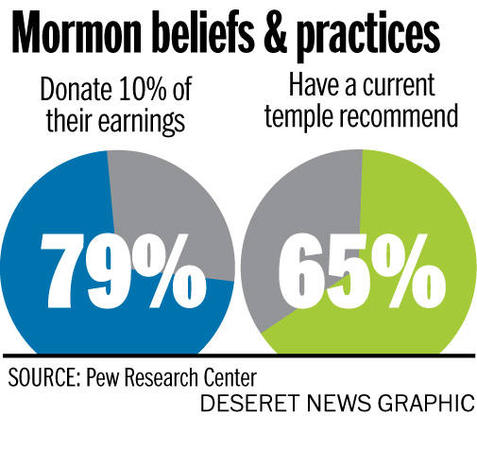
In terms of religious beliefs and practices, the survey makes it clear that Mormons are highly religious — again, not a big surprise. Eighty-two percent say that religion is very important in their lives, and 77 percent say they believe wholeheartedly in all of the church’s teachings. Fully 83 percent say they pray every day, 79 percent say they donate 10 percent of their earnings to the church in tithing and 77 percent say they attend church at least once a week. According to Pew, “Mormons exhibit higher levels of religious commitment than many other religious groups, including white evangelical Protestants.”

Looking at basic, core religious beliefs, 98 percent say they believe in the resurrection of Jesus Christ, 94 percent believe the president of the LDS Church is a prophet of God, 95 percent believe that families can be bound together eternally in temple ceremonies, 94 percent believe that God the Father and Jesus Christ are separate, physical beings and 91 percent believe that the Book of Mormon was written by ancient prophets.

Clearly, Mormons are believers.

But are they Christian? Ninety-seven percent of Mormons think so. And when asked to volunteer the one word that best describes Mormons, the most common responses were “Christian” and “Christ-centered.” By way of contrast, a November Pew Research Center survey found that nearly half (49 percent) of non-Mormon U.S. adults say that Mormonism is NOT Christian or that they are unsure whether or not it is Christian. In that same survey, when respondents were asked for one word that best describes the LDS Church, the most commonly offered response was “cult.”

Culturally, Mormon conservatism extends to a wide variety of moral issues. Polygamy (86 percent), sex between unmarried adults (79 percent), abortion (74 percent) and drinking alcohol (54 percent) are viewed as morally wrong. Divorce, on the other hand, is largely considered “not a moral issue” by respondents (46 percent).

Similarly, 65 percent of respondents said that homosexuality should be discouraged by society, compared with 58 percent of the general public who say homosexuality should be accepted by society.

“Mormons like to use the phrase, ‘Be in the world but not of the world,’” Campbell noted. “They are active and involved in their communities, but they have these beliefs and practices that set them apart a little bit, and sometimes that creates conflict or tension. [Homosexuality] is one of those issues where, rightly or wrongly, Mormons just have a different position than most of the rest of America.”

The survey also illustrates how important family life is to most members of the LDS Church. Among life’s priorities, being a good parent (81 percent) and having a successful marriage (73 percent) place higher than career concerns, having free time or even living a religious life. Some 67 percent of Mormon adults are married (compared with 52 percent of the general public), and 85 percent of them are married to another Mormon.

“As the Church and its members are increasingly the focus of media attention, we’re eager to participate in conversations that help the public get to know us better,” said LDS Church spokesman Michael Purdy. “Even though the recent Pew study did not survey any of the Church’s eight million members who live outside the U.S., it highlights some important aspects regarding who we are and what we believe.

“For example,” Purdy continued, “the study found that Church members subscribe to traditional Christian beliefs, have high moral standards, are overwhelmingly satisfied with their lives and communities, are active in serving others and have a profound dedication to family. These results reflect the Church’s message that a deep commitment to the teachings of Jesus Christ brings lasting happiness.”

Speaking for the Pew Research Center, Lugo said the idea for the survey was born last summer, “around the time that a Newsweek cover story and a New York Times article declared that the United States was experiencing a ‘Mormon moment.’”

“That got us thinking,” Lugo said in the survey’s preface.

Over the years, numerous polls have gauged public attitudes toward Mormons, who make up about 2 percent of all U.S. adults. But what do Mormons think about their place in American life? With the rising prominence of members of the LDS Church in politics, popular culture and the media, do Mormons feel more secure and accepted in American society? What do they think about other religions? What do they believe, how do they practice their faith and what do they see as essential to being a good Mormon and to leading a good life?

An advisory panel was recruited to help the Pew Forum staff create the survey. The panel featured a number of Latter-day Saints who have professional experience in Mormon studies and research, including Campbell, Cornwall, Matthew Bowman of Hampden-Sydney College, Terryl Givens of the University of Richmond and Allison Pond of the Deseret News.

“We helped them to formulate the questions, and to frame them in the kind of language that Mormons use,” Campbell said.

After a period of testing, the survey was conducted among respondents who identified themselves as Mormons (it also included qualifying questions that made it clear that respondents were members of The Church of Jesus Christ of Latter-day Saints as opposed to other churches whose members may refer to themselves as Mormons).

“Since Mormons represent about 2 percent of the population, you’d have to call 98 people before you’d get a Mormon, and that would be very expensive,” said Cornwall, who is also editor of the Journal for the Scientific Study of Religion. “But they had a fancy way of finding Mormons, including going back to Mormons they had found in the course of doing previous surveys, so they were able to get their sample in a cost-effective way.”

Care was also taken to make sure the survey included those who had land lines as well as those who have only cell phones — a growing area of concern among those who conduct public opinion research today.

Among other interesting findings of the Pew Forum’s survey of Mormons:

• 71 percent of respondents reside in the American West, including 53 percent who live in the Mountain states and 34 percent who live in Utah;

• 88 percent are white, 7 percent Hispanic, 1 percent black and 4 percent other racial and ethnic backgrounds;

• 50 percent say that evangelical Christians are generally unfriendly to Mormons;

• 54 percent say that the way their religion is portrayed on television and in movies hurts society’s image of Mormons;

• 57 percent of Mormons said that most or all of their close friends are other Mormons (this number was significantly higher in Utah, where the number climbed to 73 percent);

• 65 percent of respondents say they hold a current temple recommend;

• 27 percent say they believe in yoga not just as exercise but as a spiritual practice;

Pew Study on Mormons in America

• 11 percent say they believe in reincarnation;

• 74 percent were raised in the LDS Church;

• 59 percent of converts cite the church’s beliefs as the main reason they joined the church;

• 59 percent of converts joined the church between the ages of 18 and 35;

• 27 percent have served a full-time mission, including 43 percent of men and 11 percent of women;

• 82 percent say they have a supply of food in storage, and 58 percent keep at least a three-month supply.

The margin of error for the survey is =/- 4.5 percentage points.

“I think this survey is a really good summary of the hyper-committed Mormon community that shows up at church every week,” Cornwall said. “I’m not sure it captures Mormons on the margins very well, but that’s OK — hopefully we can do that the next time. Meanwhile, this is a pretty good picture — and an interesting picture — of Mormons.

By Joseph Walker, Deseret News

Additional Resources:

Full original source Deseret News article: Pew Study on Mormons in America.

Learn more about the results of this survey of Mormons in America.

See infographic from the Deseret News article.

Pew Mormon Study Highlights Christianity.

Jan 4

Valerie Steimle is a member of The Church of Jesus Christ of Latter-day Saints (“Mormon”). She has been writing as a family advocate for the past 20 years. She is the mother of nine children living in southern Alabama and is the author of four books and a weekly newspaper column, Thoughts from the Heart.

How many times have you come home from a rough day or a trip out of town and collapsed on the couch to recover?  You stay put for a while and your body wants to unwind but something is missing.  The thought comes to you that listening to your favorite music will do the trick and you push the play button of something you love to hear, sit back down on the couch and begin to relax. Family members will respond to a hard day of school and work when soothing music is played at home.

Mormon Tabernacle ChoirChallenges are in everyone’s life yet music makes a difference.  Music does a lot for your spirit whether for good or evil.  It has a remarkable effect on people without them ever knowing.  I love the remarks of Dr. Oliver Sacks, a neurologist in New York City who wrote “Awakenings.” From an article written in the Parade Magazine, March 31, 2002, (“When Music Heals Body and Soul”), Dr.  Sacks said he knew what effects music had in a person’s life but didn’t feel the need to listen to music until he fell and damaged the nerves and muscles of one leg. As he lay in the hospital, he couldn’t get any music on the radio so a friend brought him a tape recorder and tape of his favorite music.  That music helped him find his rhythm in walking on that leg and he credits his fast healing to the music he listened to.  It is truly amazing what soothing, inspirational music can do. Read the rest of this entry »